
Coordinate Group Transport for Melbourne Weddings
Learn how to coordinate group transport for weddings with run sheets, pickup hubs, and guest logistics. Plan a seamless day and get a quote. Discover.
Table of Contents
- Step 1: Map Your Wedding Transport Timeline Template
- Step 2: Choose Vehicles and Understand Wedding Bus Hire Prices
- Step 3: Set Up Pickup Hubs and Manage Guest Flow
- Step 4: Coordinate Arrival Windows and Venue Logistics
- Step 5: Plan Late-Night Return Shuttles and Contingencies
- Step 6: Book Luxury Chauffeur Services for Weddings
- Frequently Asked Questions
Last Updated: September 16, 2026
Step 1: Map Your Wedding Transport Timeline Template
Coordinating group transport for Melbourne weddings starts with one document: a wedding transport timeline template listing every pickup, vehicle and arrival window against the ceremony and reception times. This guide from DriveToArrive covers how to build, price and run one.
The template is your single source of truth. Without it, guest logistics collapse into morning-of phone calls; with it, a coordinator can move 80 guests across three suburbs without a missed pickup.
Build the timeline backwards from the ceremony start time. Work in this order:
- Ceremony start and the latest acceptable arrival (usually 20-30 minutes before)
- Travel time between each pickup hub and the venue, plus a 15-minute buffer
- Photographer and bridal party departure times
- Reception start and the gap between ceremony and reception
- Final guest departure time and the number of return shuttles needed
Key Timings to Lock In
Lock the ceremony arrival window first, then work backwards, every other timing depends on it.
The bridal party, immediate family and elderly guests usually travel separately from general guests, so plan at least two departure times per hub: an early group and a main group. Confirm the ceremony duration with your celebrant, then add the photo session length before the reception.
Step 2: Choose Vehicles and Understand Wedding Bus Hire Prices
Wedding bus hire pricing stacks four variables: vehicle class, minimum hire block, kilometres travelled and time of day. Two quotes for the same 50-seat coach can differ significantly, so ask operators to break quotes into those four lines before comparing.
Most charter operators quote a minimum hire period rather than a per-trip fare, with hourly rates beyond that. A per-kilometre rate usually only kicks in past a set radius from the depot, and inside that radius the fare is effectively flat.
Then come the surcharges. Late-night pickups often attract a surcharge, waiting time is billed separately if a vehicle is held beyond its slot, and public holidays can add another loading. None are hidden, but they are rarely volunteered, ask directly.
| Vehicle | Typical Capacity | Best For | Watch Out For |
|---|---|---|---|
| Maxi cab | Up to 11 | Small family groups, single-hub pickups | Limited luggage space; often no standing room |
| Minibus | 12-24 | Mid-size weddings, two pickup hubs | Tighter aisle space for formal dress; limited overhead storage |
| Coach | 40-60 | Large guest lists, single venue runs | Access restrictions at some venues; longer boarding time |
| Chauffeur sedan | 1-3 | Bridal party, VIP guests | Not a group solution; billed hourly with a minimum |
Matching Vehicle Capacity to Guest Numbers
Capacity is not comfort. A 24-seat minibus carrying 24 adults in formal wear feels full, so plan for roughly 80% of stated capacity. With 24 guests at one hub, book a 30-seat vehicle or split across two minibuses, which also covers a late-confirmed plus-one.
Boarding time is the hidden capacity killer. Allow roughly one minute per guest on a step-entry coach, longer in heels or long dresses, a 50-seat coach can take 10 to 15 minutes to load at one hub, so multi-hub routes need generous buffers.
For multi-vehicle coordination, keep every vehicle with the same operator where possible, one point of contact manages the fleet when a pickup runs late. If you must split, exchange dispatch numbers in advance and agree a shared run sheet format.
Accessibility and Inclusive Vehicle Choice
Not every bus or coach is wheelchair accessible, and few operators raise it unless asked. If you have a guest with limited mobility, an elderly relative who cannot manage coach steps, or a wheelchair user, confirm accessibility at the quote stage, not the week before.
Ask whether the vehicle has a wheelchair lift or ramp, whether the aisle allows a walking frame, and whether the driver is trained to assist boarding. Some operators supply an accessible minibus on request but need advance notice. Assign that guest to a named vehicle and note it on the run sheet.
Sustainability Considerations
Group transport is inherently lower-emission than dozens of separate car trips to the same venue. A full coach carrying 50 guests replaces roughly a dozen or more individual vehicles, cutting fuel use and congestion. Some operators offer carbon-offset options on group charters as a small per-vehicle add-on, ask before booking and get the offset confirmation in writing.
Step 3: Set Up Pickup Hubs and Manage Guest Flow
Pickup hubs reduce stops and keep guest flow predictable. Choose two to four based on where guests are staying, then assign each guest to a hub in advance, not on the day.
Hotels, serviced apartments and a central suburban meeting point work well. Avoid residential streets where a coach cannot legally stop, and confirm each hotel allows a bus in the driveway.
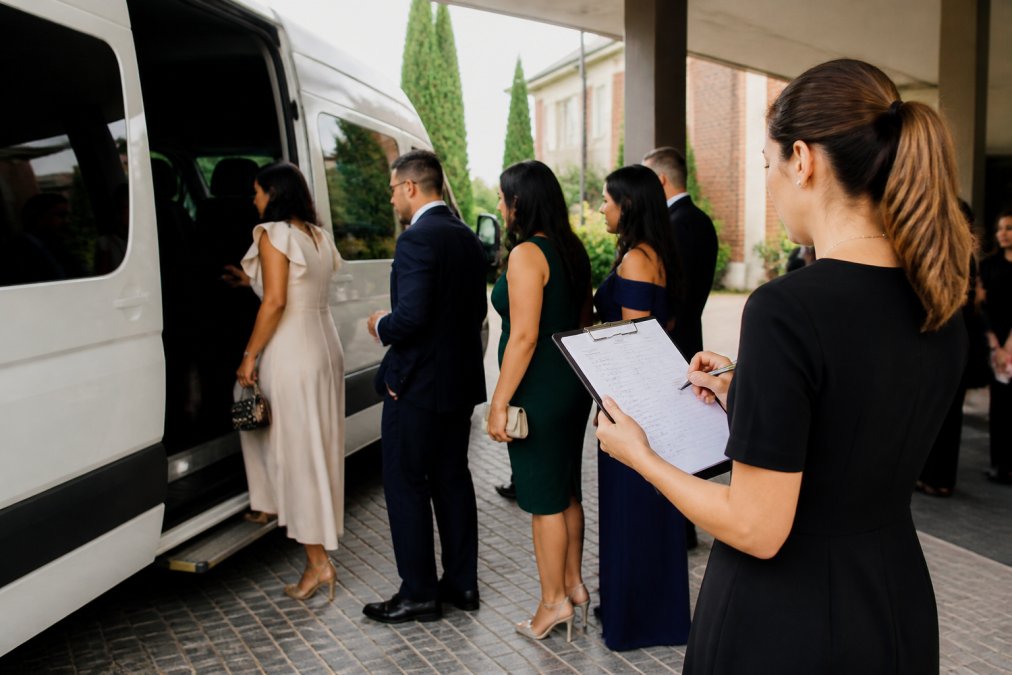
Publish a simple itinerary to guests two weeks out with the hub address, pickup time and coordinator's mobile number. Most missed pickups happen because a guest did not know their assigned hub.
Step 4: Coordinate Arrival Windows and Venue Logistics
Arrival windows keep vehicles from bunching at the venue. Give each vehicle a 10 to 15-minute slot rather than a single arrival time, and share the schedule with the venue coordinator.
Venue coordination covers three things: where vehicles stop, where they wait, and how guests disembark. Confirm all three in writing before the wedding day.
Step 5: Plan Late-Night Return Shuttles and Contingencies
Late-night return shuttles are the most commonly under-booked part of wedding transport. Guests leave at different times, so plan return capacity in waves and build a contingency layer most couples never consider until something goes wrong.
Building a Plan B for Traffic and Road Closures
This is the gap most wedding transport guides skip. Road closures, major events and arterial congestion can turn a 20-minute transfer into an hour, and a run sheet with no fallback will fail, build a Plan B before the day.
Using Digital Tools to Track Guest Transport
Shared spreadsheets, group messaging and RSVP platforms let you update hub assignments in real time, so a late change reaches every guest at once, but the tool matters less than keeping one master list.
Contingency Checklist
- A named coordinator on the ground with the operator's dispatch number
- One spare seat on every vehicle for a guest who needs to leave early
- A backup plan if a vehicle breaks down, confirmed with the operator in advance
- A wet-weather plan for outdoor pickup points
- A printed run sheet in every vehicle, including alternate routes
- A delay protocol with a named decision-maker and a 15-minute trigger
- Accessibility notes flagged against specific guests and vehicles
The run sheet wins or loses the day. Build it backwards from the ceremony, publish it two weeks out, keep one coordinator responsible for every pickup and return, and never send a vehicle out without a Plan B route in the driver's hand.
Step 6: Book Luxury Chauffeur Services for Weddings
Luxury chauffeur services for weddings cover the bridal party, immediate family and VIP guests who should not travel by bus. This is a separate booking from group transport and needs its own timeline.
Frequently Asked Questions
What is the 30-minute rule for wedding transport?
The 30-minute rule means guests should arrive at the ceremony venue at least 30 minutes before the bride. This buffer covers parking, seating, and last-minute delays. For group transport, build this into your run sheet so shuttles drop guests early. If the ceremony starts at 3pm, aim for guest arrival by 2:30pm. This reduces stress and keeps the timeline on track.
How do you create a wedding transport schedule for guests?
Start with a wedding transport timeline template that lists every pickup and drop-off point. Include addresses, times, guest names, and vehicle details. Share it with drivers and your coordinator. Build in 15-minute buffers between stops. Print copies for each vehicle and send digital versions to guests. Review the schedule with your transport provider a week before the wedding to confirm all details.
How much does it cost to hire a bus for a wedding?
Wedding bus hire prices depend on vehicle size, distance, and hours. Weekend and peak-season rates are higher. Most companies quote per vehicle, not per person. Request a fixed quote that includes fuel, tolls, and driver time. Avoid providers that add surcharges on the day.
Should I provide transport for wedding guests between venues?
Yes, if your ceremony and reception are more than 15 minutes apart. Guests appreciate not driving after drinking. Group transport also keeps everyone together and reduces parking issues. For venues within walking distance, you may skip it. But for rural or city venues with limited parking, a shuttle service is worth the cost. It improves guest experience and keeps your timeline predictable.
Coordinating group transport for a wedding comes down to one document, one coordinator and one operator who answers the phone at 11pm. DriveToArrive handles the fleet side with fixed prices, a named chauffeur on every trip and 24/7 support, so your run sheet holds together from the first pickup to the last return. Get started with DriveToArrive and book your wedding transport with confidence.
Vehicles, arrivals and behind-the-scenes from our chauffeur teams around Australia.