
Etiquette for Transporting Funeral Flowers and Belongings
Learn the etiquette for transporting funeral flowers and belongings with care. Practical tips for keeping tributes fresh and handling keepsakes.

Table of Contents
- Why Careful Transport Matters: Etiquette for Funeral Flowers and Belongings
- How to Keep Funeral Flowers Fresh During Travel
- Etiquette for Handling Funeral Keepsakes and Personal Belongings
- What to Avoid Sending and Common Transport Mistakes
- When to Use Professional Funeral Transfer Services
- Vehicle Safety and Post-Service Transport Logistics
- Frequently Asked Questions
Last Updated: September 15, 2026
Why Careful Transport Matters: Etiquette for Funeral Flowers and Belongings
When a sympathy arrangement arrives crushed, the family absorbs that disappointment on one of the hardest days of their lives. Etiquette for transporting funeral flowers and personal belongings protects two things: the tribute and the family's trust.
This guide covers preparation, vehicle safety, cultural considerations, and when a professional service makes more sense than a personal favour.
How to Keep Funeral Flowers Fresh During Travel
The biggest threat to fresh funeral flowers during travel is heat, followed by dehydration and physical damage. A closed car on a warm day can wilt delicate blooms within an hour, so timing and preparation matter more than any product (Record-breaking heatwave leaves some flower farmers without Valentine's Day blooms).
A few practical rules cover most situations:
- Move arrangements in the coolest part of the day, ideally early morning or evening
- Keep the vehicle's air conditioning running, directed away from direct blasts on the petals
- Never leave flowers in a parked car, even briefly, on a warm day
- Support tall stems so they don't snap in transit
If you're collecting from a florist, ask them to wrap the arrangement. Most secure stems with damp paper and a plastic sleeve, buying you valuable time.
Preparing Arrangements Before You Leave
Before an arrangement goes near a vehicle, it needs to be stabilised. Loose blooms, trailing greenery, and unwieldy sprays will shift, bruise, or topple the moment you brake.
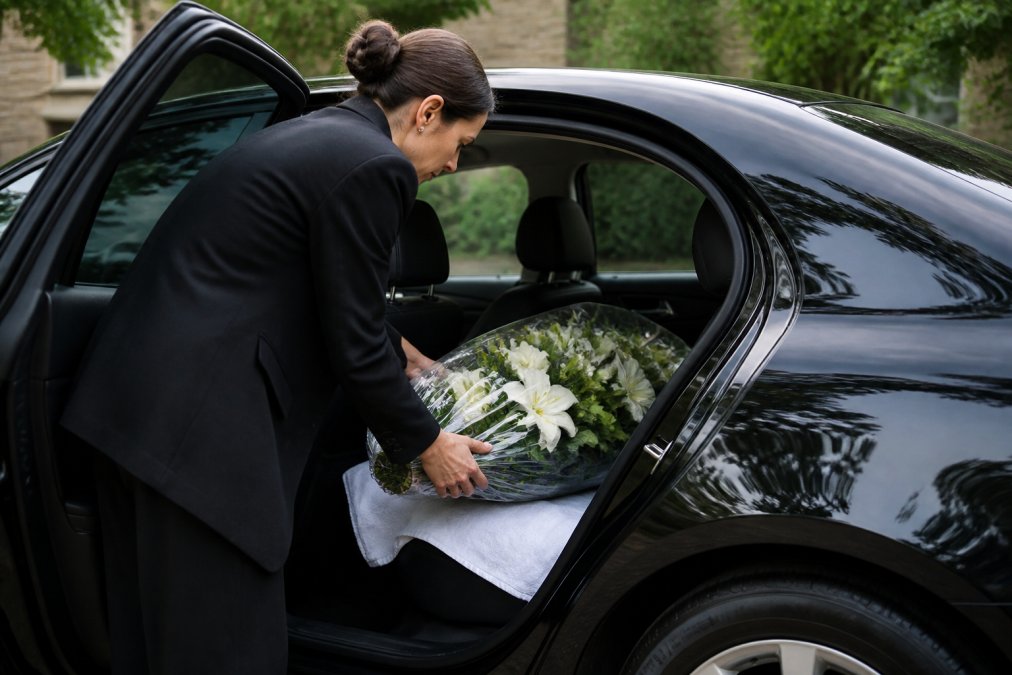
For a wreath or standing spray, lay it flat on a clean sheet or towel rather than propping it upright. For a vase arrangement, drain excess water, wrap the vase base in a towel, and place it in a box or laundry basket so it can't roll. A common mistake is carrying a full vase of water on a lap or seat: one sharp turn means a soaked interior and a ruined tribute. Empty most of the water, wrap the stems in wet paper or a damp cloth, and refill at the venue.
Managing Water and Spills in the Vehicle
Water damage is the most common transport complaint, and it's almost entirely preventable. Line the boot or seat with a thick towel or plastic sheet, and place arrangements so they can't slide into each other.
Keep a small kit in the car: paper towels, a plastic bag for wet stems, and a spare towel. Blot spills immediately rather than letting water soak into upholstery.
Etiquette for Handling Funeral Keepsakes and Personal Belongings
Keepsakes and personal belongings carry a different kind of weight than flowers. These are the items the family has chosen to place with their loved one or to keep: photographs, a favourite watch, a letter, a child's drawing, a military medal.
The etiquette here is simple but strict. Handle every item as if the family is watching, because often they are. Ask before you touch anything, confirm where each item should go, and never assume what's appropriate. If you're unsure whether an item should be buried, cremated, or returned, ask the funeral director.
The Three Categories of Belongings
Before anything is moved, sort each item into one of three categories, which determine where it goes and who is responsible.
- Items to be placed with the deceased. Photographs, letters, a favourite tie, a small soft toy, a rosary. These are committed to the coffin or casket and are not returned. Confirm with the funeral director before the service, because once the lid is closed, the decision is final.
- Items to be displayed at the service. Medals, framed photographs, a uniform, a musical instrument, a favourite book. These travel to the venue, sit on a memory table or beside the casket, and come home afterwards. They are the items most likely to be damaged or lost in transit.
- Items to be kept by the family. Jewellery, watches, documents, digital devices. These should never travel in the same bag as display items, because the two get separated at exactly the wrong moment.
A common pattern is one nominated keeper of category three, who carries a single labelled bag and never leaves it in a vehicle or cloakroom.
Jewellery, Watches and Items of Value
Jewellery is the most disputed category of personal belonging at a funeral. Rings, watches and chains are small, valuable, and emotionally loaded, and families frequently disagree about whether an item should be buried, cremated, or kept.
A few rules reduce the risk:
- Confirm in writing, or at least by text message, who authorised an item to be placed with the deceased. A verbal agreement between siblings is not enough when the item is a grandmother's ring.
- Photograph the item before it leaves the family home. A dated phone photo resolves most later disputes.
- If the item is to be cremated, precious metals do not survive the process intact. Most crematoria remove metal items beforehand, and some return them to the family afterwards. Ask the funeral director, because practice varies.
- Never place an item in a coffin without telling the funeral director. Coffins are sealed and transported, and an undeclared item can be lost between chapel and crematorium.
Photographs, Letters and Paper Items
Paper is fragile in a way most people underestimate. A photograph loose in a handbag will crease, a letter in a coffin may be affected by condensation, and a child's drawing taped to a wreath will not survive a warm car.
For displayed items, use a rigid folder or clear plastic sleeve inside a box, kept flat. For items placed with the deceased, ask the funeral director whether the coffin lining will protect them, and consider a sealed envelope rather than a loose sheet. For items being kept, scan or photograph them before the service; the digital copy is often the one the family actually uses afterwards.
Digital Belongings and Online Accounts
A growing category most guides ignore is digital belongings: social media accounts, email, cloud photo libraries, and subscription services. These carry the same emotional weight and require the same care.
In Australia, access to a deceased person's digital accounts is governed by each platform's terms of service and by state and territory succession law, not a single national rule (Part 2: Definition of personal information). Most major platforms have a legacy contact or memorialisation process, easier to set up before death than to invoke afterwards.
Transporting Belongings: A Practical Checklist
What to Avoid Sending and Common Transport Mistakes
The most common transport mistakes:
When to Use Professional Funeral Transfer Services
Vehicle Safety and Post-Service Transport Logistics
How to Secure Floral Arrangements in a Vehicle
Post-Service Transport: Who Takes the Flowers Home?
A simple division of responsibility avoids most problems:
Eco-Friendly Transport and Disposal
A Quick Pre-Drive Check
Run through this list before the vehicle moves:
| Situation | Best Approach | What to Avoid |
|---|---|---|
| Single small arrangement | Personal vehicle, towel-lined seat | Full vase of water |
| Multiple arrangements | Boxed, laid flat, secured | Stacking and crushing |
| Long-distance transport | Professional transfer service | Leaving flowers in a hot car |
| Fragile keepsakes | Padded hard case, labelled | Loose in a bag or pocket |
| Post-service flowers | Compost, donate, or preserve blooms | Discarding to landfill |
Frequently Asked Questions
What is the most respectful way to transport funeral flowers in a private vehicle?
Place arrangements flat on a towel or plastic sheet in the boot or back seat to prevent water damage. Secure taller wreaths with a seatbelt or ask a passenger to hold them. Keep the vehicle cool and avoid direct sunlight. If the arrangement is large or fragile, a professional funeral transfer service can transport it safely and with dignity, ensuring the floral tribute arrives intact for the service.
Should funeral flowers be kept in water during transit?
For short trips under an hour, drain excess water and wrap stems in damp paper towels or a plastic sleeve to prevent spills while keeping blooms hydrated. For longer journeys, use florist-approved water tubes or transport the arrangement in a lined container. This approach is part of the etiquette for transporting funeral flowers, balancing freshness with protecting the vehicle interior and other passengers.
How do you safely transport fragile personal belongings to a funeral service?
Wrap delicate items such as framed photos, ceramics, or jewellery in soft cloth or bubble wrap and place them in a rigid box lined with padding. Secure the box on the floor behind a seat rather than on an elevated surface. Keep small keepsakes in a zipped bag you hold. For valuable or sentimental items, consider a professional funeral transfer service with a named chauffeur who can manage logistics discreetly.
What should you do if funeral flowers are damaged during transport?
If petals or stems are bruised, trim damaged ends at an angle and place the arrangement in fresh water as soon as possible. Minor damage can often be hidden by rearranging blooms. If the tribute is badly affected, contact the florist or the funeral director, who may be able to provide a replacement or adjust the display. For future trips, use a professional funeral transfer service to reduce handling risks.
Vehicles, arrivals and behind-the-scenes from our chauffeur teams around Australia.