
Planning Logistics for Large Group Outings in Melbourne
Planning logistics for large group outings in Melbourne: Master group outing logistics in Melbourne with our practical guide. Learn to manage transport.
Table of Contents
- Start with Clear Event Objectives and Budget Allocation
- Venue Sourcing and Capacity Planning for Large Groups
- Corporate Group Transport Solutions: Moving Teams Efficiently
- Managing Group Travel Logistics: Coordination and Contingencies
- Transportation Planning Checklist for Events: From Run Sheets to Risk Assessments
- Catering, Dietary Requirements, and Vendor Negotiation Tactics
- Sustainable Event Planning and Hybrid Logistics: Future-Proofing Your Outing
- Conclusion: Ensuring a Smooth Group Outing
- Frequently Asked Questions
Last Updated: September 12, 2026
Start with Clear Event Objectives and Budget Allocation
Planning logistics for large group outings in Melbourne starts with one question: what does success actually look like? A client roadshow, a team offsite, or a conference cohort each demand a different logistical spine, and the objectives you set in week one determine every vendor decision that follows.
Here's what most organisers get wrong. They book the venue before they define the outcome, then spend the rest of the project working around a space that never quite fits the purpose. Lock the objectives first, then let the venue, transport, and catering briefs flow from them.
A practical structure looks like this:
- Purpose: client hosting, internal team building, conference attendance, or a milestone celebration
- Headcount: confirmed numbers, plus a realistic attrition buffer
- Budget allocation: split across venue, transport, catering, activities, and a contingency line
- Event KPIs: attendance rate, engagement, on-time arrival, and post-event feedback
Venue Sourcing and Capacity Planning for Large Groups
Venue sourcing is a capacity and access problem before it is an aesthetic one. A space that photographs beautifully can still fail a group of 80 if the loading access, bathroom ratio, or parking cannot handle the volume.
Work through this sequence:
- Set your minimum and maximum headcount, then shortlist venues that comfortably sit at your upper number
- Check venue capacity against seated, standing, and mixed-format configurations
- Confirm accessibility provisions for attendees with mobility requirements
- Verify event infrastructure: power, AV, climate control, and weather cover
- Inspect loading access and nearby public transport before signing
For outdoor options, ask directly what happens in poor weather. A venue with a genuine wet-weather plan is worth more than one with a better view.
Corporate Group Transport Solutions: Moving Teams Efficiently
Corporate group transport solutions live or die on two things: a single point of coordination and a fleet that scales with your headcount. Splitting a group across multiple providers to save a little on paper usually costs more in missed pickups and confused attendees.
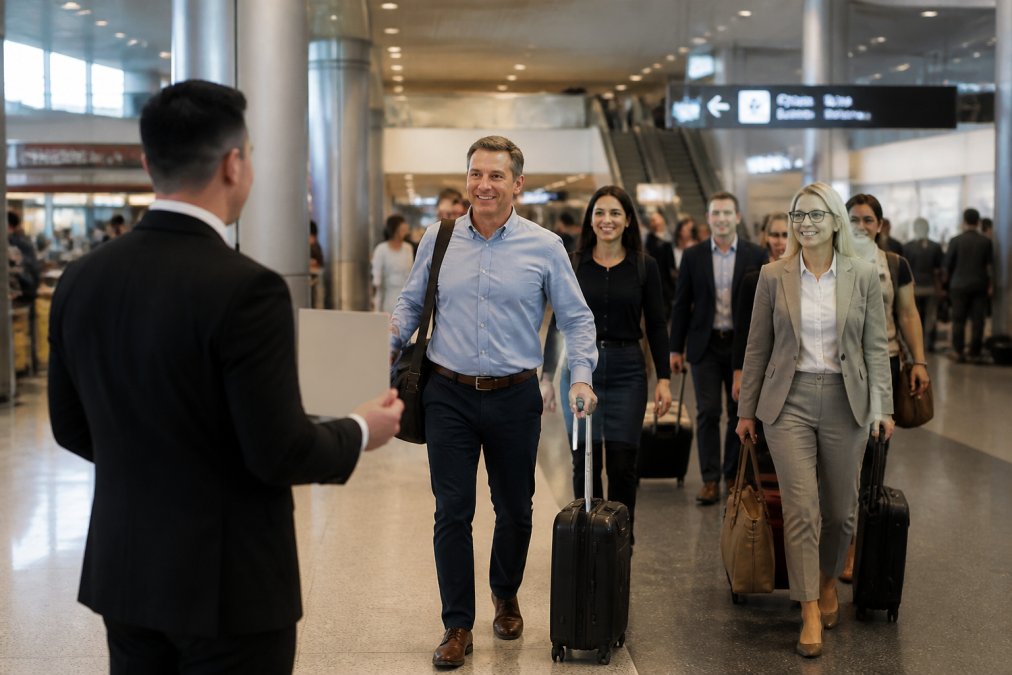
For airport arrivals, the operational detail that matters most is flight tracking. When a group is landing across several flights, a provider that monitors arrival times and adjusts pickup automatically removes an entire layer of coordination from your plate.
DriveToArrive handles group charters and airport transfers with flight tracking and a waiting time confirmed on your booking, which matters when a cohort clears customs at different speeds. Named chauffeurs recorded against each trip also give you a clean audit trail for stakeholder reporting.
Managing Group Travel Logistics: Coordination and Contingencies
Managing group travel logistics is the discipline of holding one master schedule that every stakeholder can see. The run sheet is that document, and it should carry arrival times, pickup points, driver contacts, and venue addresses in a single place.
What most guides miss is the cost of fragmented itineraries. When half the group travels independently and half is on a charter, you need both streams reconciled against the same run sheet or you will lose people between venues.
Build the run sheet as a single source of truth
A run sheet that survives contact with a real event has five columns, not three:
- Time block, arrival window, not a single minute, so latecomers have a slot to land in
- Leg, pickup point to drop-off point, named precisely (for example, "Southern Cross Coach Terminal, Bay 4" rather than "the station")
- Party, who is travelling on this leg, by name or group code, so drivers can reconcile headcount
- Owner, the one person accountable for that leg being on time
- Contingency, the fallback if the leg slips, written before the day, not improvised on it
Distribute the run sheet to attendees, drivers, and venue contacts at least 48 hours ahead, then reissue a final version the evening before (business.gov.au). Version-control it: number each issue and tell recipients to discard earlier copies. A run sheet with two live versions is worse than no run sheet at all.
Nominate one logistics lead with real authority
A common pattern is a committee where everyone owns a piece and no one owns the whole. That fails on the day. Nominate one logistics lead with authority to make on-the-day calls, rerouting a charter, releasing a held vehicle, or moving a lunch booking, without waiting for sign-off. Give that person a named deputy so the role does not collapse if they are stuck on a call.
Weather contingency planning: the four-seasons problem
The single biggest logistical risk for outdoor and semi-outdoor group outings is a day that delivers sun, wind, and rain inside a few hours. Most guides treat weather as a footnote. Treat it as a plan.
A workable weather contingency has three tiers:
- Light rain, covered outdoor space, umbrellas, and a shortened walking route. Confirm the venue has a covered area large enough for your full headcount, not just a token awning.
- Heavy rain or high wind, a fully indoor alternative venue or room, pre-booked or held on a first-refusal basis, with the trigger decision made by a set time (for example, 7am on the day).
- Severe weather or transport disruption, a cancellation and rescheduling protocol, including who communicates to attendees and how quickly.
Write the trigger, the decision-maker, and the communication channel into the run sheet. A contingency that lives only in someone's head is not a contingency.
Reconcile independent and chartered travel streams
When part of the group self-drives or catches public transport and part is on a charter, reconcile both against the same run sheet. Set a hard "all-in" time at each venue, the point after which the group moves regardless, and nominate a person to sweep for stragglers. Build buffer time between every leg, particularly for group transport, and treat the buffer as non-negotiable rather than something to reclaim if the morning runs early.
Keep one live contact channel
Use a single channel for real-time updates, a group message thread or a dedicated event line, and keep it separate from the channel attendees use for general chat. Drivers, the logistics lead, and venue contacts belong in the operational channel; everyone else belongs in the social one. Mixing them buries the one message that matters.
Transportation Planning Checklist for Events: From Run Sheets to Risk Assessments
A transportation planning checklist for events should be completed before the event, not during it. This is the document that turns a good plan into a resilient one. The table below is a starting structure; the notes beneath it are where most organisers lose time.
| Stage | Action | Timing |
|---|---|---|
| Pre-event | Confirm headcount, pickup points and accessibility needs | 3 weeks out |
| Pre-event | Book group transport and confirm fleet size against final numbers | 2-3 weeks out |
| Pre-event | Complete risk assessment and accessibility review | 2 weeks out |
| Pre-event | Confirm hybrid/remote participation requirements | 2 weeks out |
| Pre-event | Distribute run sheet to all parties | 48 hours out |
| On the day | Confirm driver arrivals and monitor delays | Morning of event |
| Post-event | Collect attendee feedback and reconcile invoices | Within 1 week |
Risk assessment: name the risk, name the owner
A risk assessment that lists categories without owners is decoration. For each risk, record the likelihood, the impact, the mitigation, and the person who acts if it materialises. The categories worth covering for a large group outing:
- Transport delay, a charter held in traffic, a flight delayed, a public transport disruption. Mitigation: buffer time, a held backup vehicle, and a named escalation contact at the transport provider.
- Weather, covered by the contingency tiers in the previous section; link to them rather than duplicating.
- Accessibility barrier, a step at a venue entrance, a vehicle without a ramp, a route with no seating. Mitigation: confirm in writing with every venue and provider, and walk the route if you can.
- Medical or welfare incident, a named first-aider, a stocked kit, and a clear route to the nearest hospital.
- Lost attendee, a sweep protocol and a single meeting point per venue.
Accessibility and inclusivity: confirm, don't assume
Accessibility is a planning input, not a post-booking adjustment. Collect requirements at registration, mobility, dietary, sensory, and any need for a support person, and pass them to venues and transport providers in writing (humanrights.gov.au). Confirm the specifics that matter: step-free access, accessible bathrooms, a vehicle with a ramp or lift, and a quiet space for anyone who needs a break. If a venue cannot confirm a requirement in writing, treat it as unmet and find an alternative.
Hybrid logistics: the gap most guides skip
If any part of your group is joining remotely, you are running two events on one run sheet. Hybrid logistics add a second attendee stream with its own schedule, its own engagement plan, and its own technical owner, and that owner should not also be running ground transport.
A workable hybrid layer includes:
- A separate remote run sheet, session times, joining links, and a named host for the remote room
- A technical owner, someone whose only job is the stream, the audio, and the remote Q&A, so the logistics lead is not troubleshooting a microphone mid-event
- A shared clock, remote and in-room participants on the same schedule, with explicit time-zone notes if anyone is dialling in from interstate or overseas
- A participation mechanism, a way for remote attendees to ask questions or vote that the in-room facilitator can see and act on
- A recording and follow-up plan, who captures the session and how it reaches anyone who could not attend live
Post-event: reconcile while the detail is fresh
Collect attendee feedback within a week, while the day is still memorable, and reconcile invoices against the run sheet. Compare actual headcount, actual vehicle movements, and actual timings against the plan. The gaps you find are the input to the next event's checklist, and the reason a checklist is worth keeping rather than rebuilding from scratch each time.
Catering, Dietary Requirements, and Vendor Negotiation Tactics
Catering coordination begins with dietary requirements collected at registration, not guessed at the venue. A simple field in your RSVP form removes almost all of the last-minute scramble.
Vendor negotiation tactics that actually work with group catering and transport suppliers:
- Ask for a fixed price with a written inclusions list, not a per-head estimate
- Confirm cancellation terms and any late-change fees before signing
- Request a named account contact, not a general booking line
- Ask what happens if numbers drop in the final week
Sustainable Event Planning and Hybrid Logistics: Future-Proofing Your Outing
Sustainable event planning and hybrid logistics are the two angles most organisers still treat as afterthoughts, and both are becoming standard expectations. Sustainability in group outings usually comes down to consolidation: fewer vehicles moving more people, digital run sheets instead of printed packs, and venues reachable by public transport.
Hybrid logistics add a second attendee stream to manage. Remote participants need their own schedule, their own engagement plan, and a technical owner who is not also running ground transport.
For group travel, a shared charter with a fixed route typically beats a fleet of individual trips on both cost and emissions. It also gives you one itinerary to manage rather than a dozen.
Conclusion: Ensuring a Smooth Group Outing
The difference between a smooth outing and a stressful one comes down to preparation: clear objectives, a venue that fits your numbers, one coordinated transport plan, and a run sheet everyone can see. Get those right and the day largely runs itself.
DriveToArrive supports corporate group transport with fixed pricing, flight tracking, a 60-minute free airport wait, and consolidated monthly invoicing for corporate accounts. For teams moving large groups across the city, our group charter and event transfer services are built for exactly this.
Get started with DriveToArrive and give your next group outing a transport plan you do not have to think about.
Frequently Asked Questions
What are the most efficient transport options for large groups in Melbourne?
For groups over 10 people, private charters and minibuses are often more efficient than multiple rideshares. They keep the group together, reduce coordination stress, and can be scheduled to avoid peak-hour delays. Look for providers with fixed pricing and flight tracking if airport transfers are involved. Always confirm vehicle capacity and luggage space in advance.
How do you manage group movement between multiple venues?
Create a detailed run sheet with pickup times, addresses, and contact numbers. Use a single point of contact for each vehicle and share the itinerary with all attendees. Build in buffer time for traffic and loading. For larger groups, stagger departures or use multiple vehicles with assigned group leaders to prevent bottlenecks.
What are the key logistical challenges when planning corporate outings?
Common challenges include coordinating transport for large numbers, managing dietary requirements, ensuring punctuality, and handling last-minute changes. Weather can also disrupt outdoor activities. Mitigate these by confirming vendor capacities, creating contingency plans, and using professional transport with fixed pricing and 24/7 support to handle disruptions.
How can you ensure punctuality for large group arrivals?
Book transport with flight tracking and a generous free waiting period, such as 60 minutes for airport pickups. Provide drivers with real-time flight updates and a single contact for the group. Schedule arrivals outside peak traffic times where possible. For events, have a dedicated greeter to direct attendees to vehicles quickly.
Vehicles, arrivals and behind-the-scenes from our chauffeur teams around Australia.